
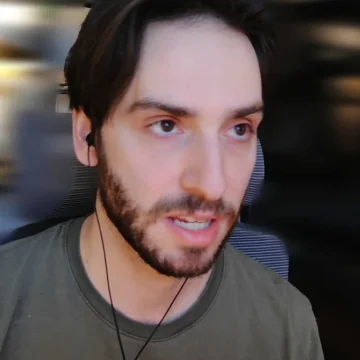
Guest on 2D Is Against My Religion
Michael Rubloff
Founder, Radiance Fields
Michael Rubloff founded Radiance Fields (radiancefields.com), which documents NeRF, Gaussian splatting and other lifelike 3D research and applications. On 2DIAMR, Michael Rubloff explained how Gaussian splatting differs from NeRFs and photogrammetry, which parts use AI, and where the technology is being adopted, from city models to film and robotics.
Episode
 1 h 35 min
Podcast
Gaussian splatting, NeRFs and AI explained: Michael Rubloff of Radiance Fields
Michael Rubloff · Radiance Fields
In Michael’s words
“Gaussian splatting does not use AI, though they are both compatible with additional layers of artificial intelligence.”
“All of the options should have a very high ceiling on them.”
“I personally am convinced that it's a full-on imaging medium in the same way that we've had photography.”
Questions Michael answered
- What is 3D Gaussian splatting?
- Michael Rubloff describes it as a way to reconstruct lifelike 3D from ordinary photos or video: hundreds of thousands to millions of 3D ellipsoids that reproduce view-dependent effects such as reflections, glass, foliage and thin structures. ▶ 0:05
- Does Gaussian splatting use AI?
- Not in its pure form, according to Michael Rubloff: the original NeRF uses a small neural network (MLP), while Gaussian splatting uses no AI – though both can be combined with AI layers, for example an LLM to query a scene. ▶ 10:55
- What is the difference between NeRF and Gaussian splatting?
- Both are radiance fields, says Michael Rubloff, but NeRF ray-casts from the camera and samples points along each ray through a neural network, while Gaussian splatting rasterizes 3D Gaussians initialised from a sparse point cloud. ▶ 8:59
- Is Gaussian splatting as accurate as photogrammetry?
- Michael Rubloff thinks it should become as accurate, because it uses the same structure-from-motion alignment, but agrees that as of January 2026 splatting favours the visual result – so it is best run in parallel with photogrammetry. ▶ 20:39
- Which software can I use to train and edit Gaussian splats?
- Michael Rubloff recommends Postshot, LichtFeld Studio and Brush for local training, and SuperSplat from PlayCanvas for cleaning (floater removal in rings mode) and sharing splats on the web. ▶ 76:06
Talks about
Related guests
- Josip Rukavina – Vectrino
- Rami Tamimi – Geomatics project manager and Ph.D. candidate, WSP
- Olli Huttunen – 3D Gaussian Splatting creator
- Tomáš Barnáš – Co-founder of LumiSway and Overhead4D; producer of Smithsonian Starstruck, Overhead4D
- Alex Harvey – Co-founder, RiVR
- Łukasz Mirocha – Opus Lab; university lecturer in Hong Kong, Opus Lab