
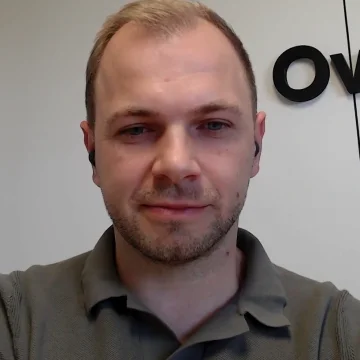
Guest on 2D Is Against My Religion
Tomáš Barnáš
Co-founder of LumiSway and Overhead4D; producer of Smithsonian Starstruck, Overhead4D
LinkedIn ↗Tomáš Barnáš co-founded the reality capture company Overhead4D and the drone show company LumiSway, produced the Smithsonian Starstruck VR experience and co-founded the 3DISE conference. On 2DIAMR, Tomáš Barnáš also co-hosts the 3DISE @ INTERGEO series.
In a live 2DIAMR session in December 2025, Tomáš Barnáš explained how Overhead4D combines laser scanning, photogrammetry and Gaussian splatting in Unreal Engine and how the team built the VR Machu Picchu experience for standalone headsets.
Episodes
 19 min
 1 h 19 min
Podcast
Astronomers rejected our Milky Way: making Smithsonian Starstruck in VR
Tomáš Barnáš, Elliott Mizroch
 57 min
Podcast
3DISE 2026 warm-up: why reality capture people fly to Prague
Tomáš Barnáš, Juraj Holub, Olaf Freier, Bert Azizoglu, Rami Tamimi, Matthew Byrd, Alex Harvey, Łukasz Mirocha, Michal Ukropec · 3DISE Conference
 1 h 14 min
Podcast
Machu Picchu in VR: how Tomáš Barnáš combines laser scanning, photogrammetry and Gaussian splatting in Unreal Engine
Tomáš Barnáš · Overhead4D
In Tomáš’s words
“When you have 3,000 drones, it means you have 3,000 pixels. But if you have 300 drones, you have 300 pixels.”
“With these 300 drones, we can really do a cool show.”
“It's crazy that even at 10 meters per second you are able to make from 300 drones one straight line in the air and they're not moving.”
“If you want to stream full experience, the maximum headsets you can have in one room is 16.”
“It's also not a task for clients to be educated in the technologies.”
“We are not replacing the reality.”
“Try to just see for what it is good, and then you can combine those technologies.”
Quoted in our tech guides
- “Try to just see for what it is good, and then you can combine those technologies.”▶ 48:30
- “It's also not a task for clients to be educated in the technologies.”▶ 21:18
- “Licenses are European, so we actually don't have a limitation. You just need to contact the right authorities, and some of them require specific permissions or specific insurances.”▶ 8:54
Questions Tomáš answered
- How are 3D scans used to design drone light shows?
- According to Tomáš Barnáš, LumiSway’s first show, for the European Capital of Culture, was designed on top of a 3D scan of the castle it flew over, so the team could simulate the show and make sure no drone crashes into the castle. ▶ 2:04
- Can a 300-drone show look as good as a 1,000-drone show?
- Tomáš Barnáš says yes: 300 drones are only 300 “pixels” and harder to design for, but with the right designers LumiSway’s 300-drone shows can compare with 1,000-drone shows that did not look much better. ▶ 9:39
- What permits does a drone show need in Slovakia?
- According to Tomáš Barnáš, each show needs at least 30 days of paperwork with air traffic control, the airport tower and, over a river, the river authorities; setting up LumiSway’s permissions took about a year. ▶ 5:31
- Can a drone show company fly anywhere in Europe?
- Tomáš Barnáš says drone show licences are European, so LumiSway has no limitation; it only needs to contact the local authorities, and some places require specific permissions or insurance. ▶ 8:54
- Can drone show drones fly in rain and wind?
- According to Tomáš Barnáš, LumiSway’s show drones resist rain and snow; rain causes more trouble for the radio signal than for the drones, and officially they should not fly in wind above 10 meters per second. ▶ 15:29
- What is Smithsonian Starstruck VR?
- According to Tomáš Barnáš, Starstruck is a roughly 40-minute VR experience – an interactive documentary – with 12 stops, guided by a flying astronaut, built on research from Smithsonian astrophysicists about the life of stars. ▶ 1:31
- Where can you see the Smithsonian Starstruck VR experience?
- At the time of recording, Tomáš Barnáš said it ran in around 10 places, including Melbourne, Chicago, Washington DC, San Antonio and Denver, with Santiago de Chile opening next and the London Science Museum among the museum venues. ▶ 70:37
- How do free-roam VR headsets stay tracked in a large venue?
- According to Tomáš Barnáš, high-contrast patterns on the floor and walls give the standalone headsets corners and edges to track, which prevents drift; some venues also use ArUco markers, similar to AprilTags, to help the experience load faster. ▶ 60:18
- How was the black hole in Starstruck made scientifically accurate?
- Elliott Mizroch says black-hole expert Laura Brenneman allowed only the Interstellar black hole as a Hollywood reference; Tomáš Barnáš adds that the team turned its dramatic fog into a flat disc and did not let visitors step inside, since no one knows what is there. ▶ 34:50
- How much space does a museum need for a free-roam VR experience?
- According to Tomáš Barnáš, the original target was museums with over one million visitors a year and 300–500 m² of space, but after Venice ran on about 80 m² – installed in four days – smaller setups are open for discussion. ▶ 73:10
- What is the Machu Picchu VR experience shown at 3DISE?
- Tomáš Barnáš says the Machu Picchu digitization became a 40-minute VR movie and a live experience where visitors wear a headset and walk around 500 square metres; as of April 2026 it was running in about 10 places worldwide. ▶ 20:36
- Is photogrammetry dead because of Gaussian splatting?
- No, according to Tomáš Barnáš: photogrammetry still produces the best 3D mesh, so laser scanning, photogrammetry and Gaussian splatting should be used as layers rather than as rivals. ▶ 15:55
- How can Gaussian splats be combined with laser scanning and photogrammetry?
- Tomáš Barnáš uses the laser scan and photogrammetry model as the reference, scales the Gaussian splat to match it and uses the splat for the surrounding backdrop, which, unlike a 360° photo, can be relit with the scene. ▶ 16:42
- What is a good workflow from photos to Gaussian splats in Unreal Engine?
- According to Tomáš Barnáš, Overhead4D registers images and laser scans in RealityScan, exports the registration to PostShot to train the splats, and then brings them into Unreal Engine, keeping one alignment for every output. ▶ 29:14
- Is RTK on a drone accurate enough, or do I need ground control points?
- Tomáš Barnáš uses drone RTK or GPS only for the first registration, because it is still about ±20 cm, especially in height; for the best accuracy the final georeferencing relies on ground control points measured with GNSS. ▶ 38:26
- Can Gaussian splats run on standalone VR headsets like the Quest 3?
- Not well yet, according to Tomáš Barnáš (as of late 2025): splats worked for Overhead4D only on streamed VR, so for the VR Machu Picchu venues the team baked the splat scenes into its own 360° backdrops for the standalone app. ▶ 50:21
Talks about
Related guests
- Alex Harvey – Co-founder, RiVR
- Rami Tamimi – Geomatics project manager and Ph.D. candidate, WSP
- Olli Huttunen – 3D Gaussian Splatting creator
- Olaf Freier – CEO, HINTE Expo & Conference (organiser of INTERGEO), INTERGEO
- Michael Rubloff – Founder, Radiance Fields
- Bert Azizoglu – CEO and co-founder, NUBIGON