
 1 h 12 min
Deep dive
XGRIDS PortalCam: LiDAR + Gaussian splatting for real estate, film and beyond
Mindy Li · XGRIDS
3D Gaussian Splatting represents a scene as millions of soft, coloured points instead of triangles. It renders photoreal captures in real time, including in the browser, but produces weaker geometry than meshes or point clouds.
Gaussian splatting went from research paper to everyday deliverable remarkably fast. Guests agree it looks photoreal and handles things photogrammetry struggles with, like glass and water – and warn that it goes soft up close and can mislead measurements.
The practical consensus across these episodes: use splats to show and share a place, use meshes, point clouds or photogrammetry to measure it, and remember that quality in still means quality out.
Start here
1 h 12 minDeep dive
Mindy Li · XGRIDS
Mindy Li on why XGRIDS pairs LiDAR with cameras to make Gaussian splatting production-ready, and how to capture glass and big mirrors.
 1 h 35 min
Podcast
Michael Rubloff · Radiance Fields
Michael Rubloff explains how splats work, how they differ from NeRFs, whether they use AI, and which tools train and edit them (as of January 2026).
 1 h 26 min
Deep dive
Jonathan Stephens · Lightwheel
Jonathan Stephens on splatting versus the splat, what a Gaussian contains, and why splat accuracy measures appearance, not geometry.
 1 h 14 min
Podcast
Tomáš Barnáš · Overhead4D
Tomáš Barnáš on how scaled, relightable Gaussian splats replaced 360° photo backdrops in Overhead4D's Unreal Engine scenes.
 1 h 25 min
Bert Azizoglu shows Gaussian splats in NUBIGON, from an animated asset in a splat scene to a city-scale splat of Munich.
 1 h 30 min
Deep dive
Josip Rukavina · Vectrino
Josip Rukavina on why, as of January 2026, splats work above water but don't yet find cracks underwater.
 1 h 17 min
Podcast
Michal Ukropec · Twinzo
Michal Ukropec on why operations customers don't ask for splats yet (as of January 2026) and where they fit better.
 57 min
Podcast
Tomáš Barnáš, Juraj Holub, Olaf Freier, Bert Azizoglu, Rami Tamimi, Matthew Byrd, Alex Harvey, Łukasz Mirocha, Michal Ukropec · 3DISE Conference
Bert Azizoglu and Łukasz Mirocha preview their 3DISE 2026 talks, including what does not work with Gaussian splats.
 1 h 24 min
Podcast
Łukasz Mirocha · Opus Lab
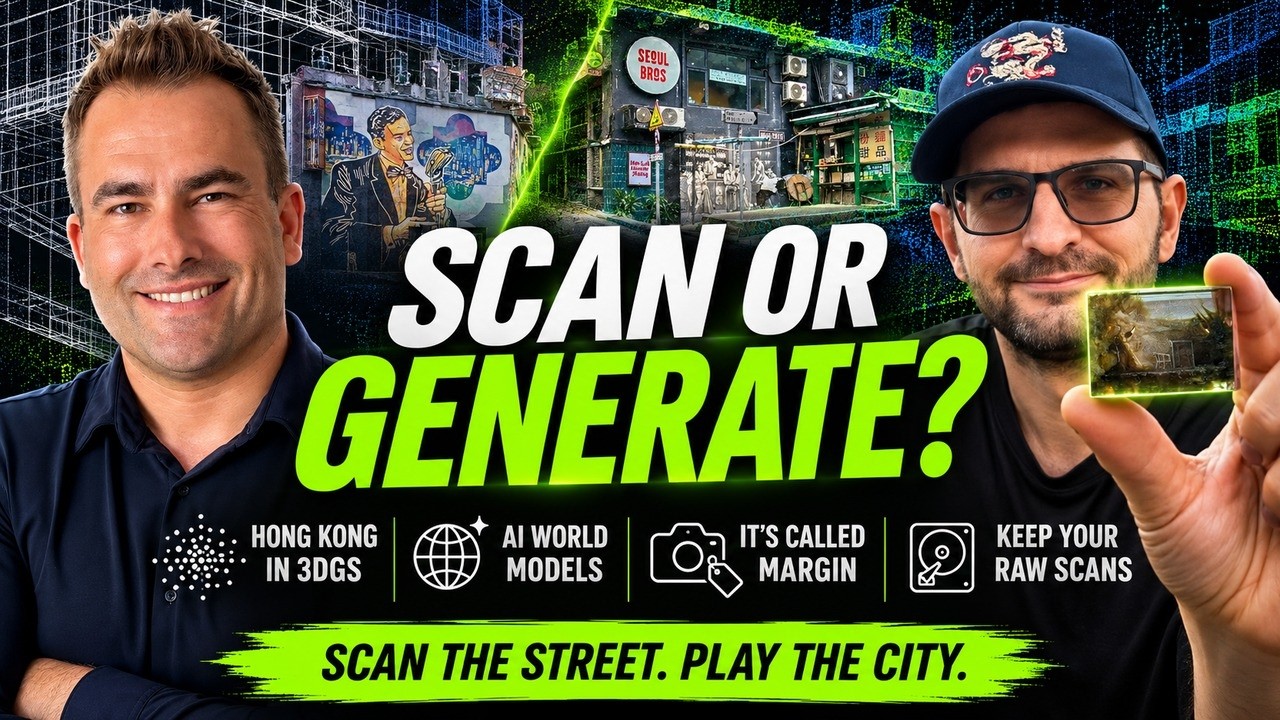
Łukasz Mirocha on building a playable Hong Kong from scanned and AI-generated splats, keeping raw scans and streaming splats with SOG.
 1 h 58 min
Olli Huttunen explains splatting in non-technical terms – pointillism in 3D – and shows how he captures and presents splats.
 1 h 39 min
Podcast
Dylan Gorman · PilotByte Labs
Dylan Gorman on when splats beat photogrammetry: water, reflective glass and visual walkthroughs.
 1 h 23 min
Arash Keissami on streaming huge splats in the browser and why NIRA adds mesh and matcap views for measuring.
 1 h 32 min
Barry Bassnett sees splats as a possible twin interface and wants surveyors to deliver them with topo surveys.
 1 h 11 min
Podcast
Alex Harvey · RiVR
Alex Harvey compares a room captured as a splat in hours with weeks of photogrammetry work for VR training.
 1 h 57 min
Bilawal Sidhu on why splats got standardised and the case for one splat of the whole world.
 1 h 48 min
Podcast
Zlata Karpushina, Mehdi Boroumand · FJ Dynamics
Zlata Karpushina on splats as a visualisation layer on top of the SLAM scanning workflow.
 55 min
Michael Schoelkopf on Gaussian splatting coming to NavVis scanners.
 23 min
Expo & conference podcast
Arek Szadkowski · Esri
Arek Szadkowski on Gaussian splats in Esri ArcGIS Reality, who pays for them and why tenders don’t ask for them yet.
 30 min
Expo & conference podcast
John Chwalibog, Fan Yang, Tobias Böhret · Manifold Tech
Tobias Böhret and Fan Yang on Gaussian splats processed in FARO’s cloud and why splats don’t need high-resolution images.
 16 min
Expo & conference podcast
Bert Azizoglu · NUBIGON
Bert Azizoglu on Gaussian splats next to point clouds and BIM models in one hybrid scene, where each validates the others.
 31 min
Expo & conference podcast
Gregor Willhauck · Trimble
Gregor Willhauck on Gaussian splats in development in Trimble Connect for UAV data from large civil projects.
 24 min
Expo & conference podcast
Aden Zhang · XGRIDS
Aden Zhang on why Gaussian splatting is not for cadastral survey and why XGRIDS made LCC open and free.
 17 min
Expo & conference podcast
Martin Piala · Blurry
Martin Piala on why Blurry moved beyond splat viewing after seeing 95% of its users still on point clouds.
 23 min
Expo & conference podcast
Ronnie Yaron · Skyline Software Systems
Ronnie Yaron of Skyline on why Gaussians are photogrammetry you can measure on, not just visuals.
 18 min
Expo & conference podcast
Jaroslav Poláček · MapTiler
Jaroslav Poláček on Gaussian splats on web maps for hotels and real estate, streamed with LODs.
 26 min
Expo & conference podcast
Jeffrey Martin, Lynn Puzzo · Mosaic
Jeffrey Martin on why global shutter cameras keep images usable for detailed splats even at scooter speed.
 17 min
In-booth interview
Cody McColl · GreenValley International
Cody McColl on the LiCam spatial camera built for 3D Gaussian splatting and on editing and merging splats in LiDAR360 MLS.
 12 min
In-booth interview
Sunny Liao · XGRIDS
Sunny Liao on why L3 splats should be “comparable or if not even better” than the PortalCam’s, and on splats as one more 3D format.
 6 min
In-booth interview
FJ Dynamics
Gaussian splats from a handheld SLAM scanner, processed in FJD Trion Model.
 19 min
Expo & conference podcast
Barry Bassnett · 3DISE Conference
 21 min
Expo & conference podcast
Alex Harvey, Laura Harvey · VIBE XR
“It's already production-ready.”
“This is exactly the same thing, but in 3D. And the computer is doing that job.”
“The biggest use case is the reproduction of water surfaces and reflected glass. Those two right there break every single time in photogrammetry.”
“Gaussian splats are great, but sometimes they can be a little bit deceiving when doing measurements.”
“Personally, I want a 3D Gaussian splat of the entire world.”
2D Is Against My Religion
2D Is Against My Religion: industry news, new technology, the latest 2DIAMR episodes and an editor’s take – a regular newsletter, short and to the point.
Free. No spam, unsubscribe anytime. Privacy
Cookies only with your consent
Analytics cookies show us what works on this site. Marketing cookies let us show you our episodes on LinkedIn and Facebook or Instagram. None of this runs without your consent. More in our privacy policy.