
In-booth interview· 12 min
XGRIDS Lixel L3: five-millimeter SLAM, a built-in screen and splats “if not even better” – Sunny Liao, XGRIDS
Watching here? Subscribe on YouTube.Get the next 2D Is Against My Religion episode in your YouTube feed.
SubscribeSummary
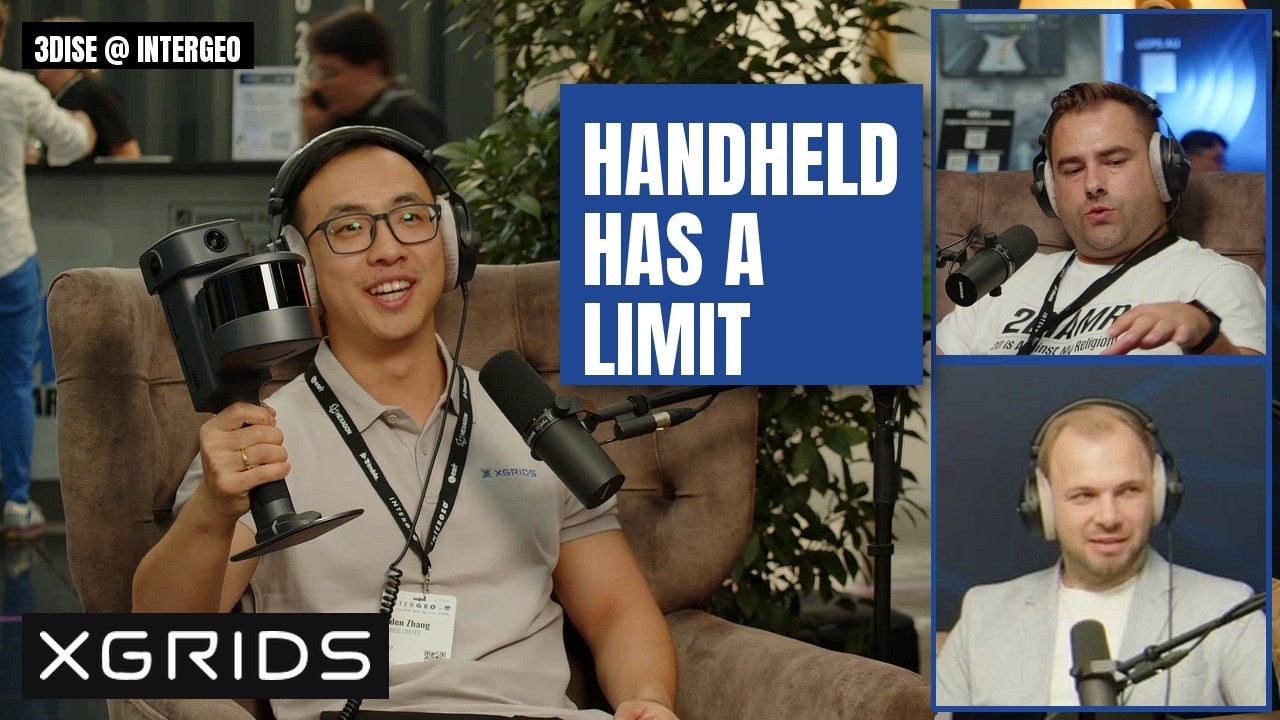
At the XGRIDS booth by the entrance of INTERGEO 2026, Sunny Liao, International Sales & Marketing Director at XGRIDS, shows Michal Gula the new Lixel L3 handheld SLAM scanner: five-millimeter accuracy, an integrated screen and RTK, and a larger camera sensor for Gaussian splats. They talk about how its splats compare with the PortalCam, what the software licence includes, cloud processing in beta, competition among SLAM makers and the XGRIDS roadmap.
Key ideas
- 1According to Sunny Liao, the Lixel L3 brings optimised algorithms with five-millimeter accuracy, an integrated screen instead of a phone connection, RTK built in and a 4K HDR camera with a 1/1.3-inch sensor; the LiDAR is the same as in the L2 Pro.
- 2Michal Gula sees the built-in screen as an answer to unstable phone connections on earlier SLAM scanners; Sunny Liao says XGRIDS cares about the workflow on site, and “taking away single point of failure is very important.”
- 3Asked whether L3 splats can match the PortalCam, Sunny Liao expects them to be “comparable or if not even better”, thanks to the upgraded camera and further firmware updates.
- 4According to Sunny, the software comes with the hardware and all processing is local, so customers own their data; premium licences add features such as map fusion and HD enhancement, and cloud processing is being released gradually, still in beta.
- 5Sunny Liao welcomes more SLAM and Gaussian splatting makers as a sign the technology reaches more customers, and names the roadmap: algorithms for tunnels and underground, more applications and a more open ecosystem.
Quotes
“Yeah, it will be comparable or if not even better.”
“It's an experience on site, so taking away single point of failure is very important.”
“Having the good data every single time is also very important, so being reliable and trustworthy.”
“The more people doing it, that means more of these technology get into hands of customers”
“Point cloud, mesh or Gaussian splat are different type of 3D formats or 3D, uh, data.”
Questions answered
- What is new in the XGRIDS Lixel L3 compared to the L2?
- According to Sunny Liao, the L3 has optimised algorithms with five-millimeter accuracy, an integrated screen so there are no more phone connection failures, RTK built in and an upgraded 4K HDR camera with a 1/1.3-inch sensor.
- Are Gaussian splats from the Lixel L3 as good as from the PortalCam?
- Sunny Liao expects L3 splats to be “comparable or if not even better”, because the camera was upgraded most and firmware and camera fine-tuning will keep improving them.
- Does the XGRIDS Lixel L3 need a software subscription?
- According to Sunny Liao, the software comes with the hardware and processing of point clouds and Gaussian splats is local, so you own your data; premium licences add features such as map fusion and HD enhancement.
- Does XGRIDS offer cloud processing?
- Sunny Liao says XGRIDS is releasing cloud processing gradually as an option, still as a beta test at the time of INTERGEO 2026.
- Does the Lixel L3 use a new LiDAR?
- No – according to Sunny Liao, the LiDAR is the same as in the L2 Pro, with the algorithm optimised for the new structure.
Chapters
Transcript
Full transcriptabout 9 min readShowHide
Transcribed automatically (ElevenLabs Scribe) and lightly edited. It may contain small errors in words or speaker names. Click a time to play the video from there.
Michal Gula: Hey, Sunny.
Sunny Liao: Hey.
Michal Gula: you have a premium location this year.
Sunny Liao: Yes.
Michal Gula: How did this happen?
Sunny Liao: Yeah, I mean, so last year, you know, looking for the best location because we definitely want to get the most crowd, of course, and, you know, we, we're very lucky to get the entrance location, so we're being very crowded since day one.
Michal Gula: I, I mean, it's crazy because when I was walking into the first hall from the entrance, I turned left and it's, it's, like, XGRIDS right away, so...
Sunny Liao: Yeah, yeah, that's the whole idea. Want to make sure everybody sees XGRIDS.
Michal Gula: Yeah, the first thing that came to my mind was like, "Oh, they must have paid a lot of money for this, premium position."
Sunny Liao: Yeah. Well, we didn't very, you know, a lot, so it was very lucky, honestly. Yeah.
Michal Gula: That- that- that's perfect. so how did you like the trade show, trade show so far?
Sunny Liao: Yeah, it's very good. It's very busy. like I said, you know, we're getting lots of attentions, and then of course with our new products, drawing a lot of attention and discussions about the upgrades and what's possible, and we're seeing lots of old faces and, and new faces, so it's, been very good.
Michal Gula: earlier this year, in Prague, during the 3DISE conference, we were very lucky as a, as a organizer that you showed the new device, the, the K2.
Sunny Liao: Yes.
Michal Gula: And, this year you have, an- or this year, just a little less than a half year later, you have another device.
Sunny Liao: Yes.
Michal Gula: It's the L- L3 Pro.
Sunny Liao: Exactly.
Michal Gula: So what's the main difference compared to the L2?
Sunny Liao: Yeah, so the L3, so I have it right here. So essentially, first off is that we are, you know, optimizing our algorithm, making sure that this is, we now have a very five, five-millimeter accuracy. And then I think a good data is important, but, you know, having the good data every single time is also very important, so being reliable and trustworthy. And then compared to the L2, you have the integrated screen so that, you know, no more connection fail issue. but we also have the, RTK integrated, also a, upgraded vision system, so essentially the camera is much better. It's a 4K HDR camera with one over 1.3, sensor.
Michal Gula: I, I like the integrated, display because, so far it was my experience, and generally with SLAM, but also with your SLAMs, the previous versions, that the connection between the, the device and the phone was not every time very stable.
Sunny Liao: Yeah.
Michal Gula: And there were al- always, like, disconnections and anything, everything else. So I think this is a good step to integrate it in, in a device.
Sunny Liao: Absolutely. Yes. We, we care a lot more about workflows, right? It's an experience on site, so taking away single point of failure is very important.
Michal Gula: I like the design of the upper side with, with the camera. So the RTK is integrated directly there?
Sunny Liao: Yeah, so the RTK is right inside. There's a RTK chip inside.
Michal Gula: Okay. Okay. what about cameras? What parameters do they have?
Sunny Liao: Yeah, so basically it's, upgraded, especially on the sensor side. It's one over 1.3 inch. So basically you have a much bigger sensor that gives you, better camera, better details, and of course, in low light or, you know, high exposure environment, you're still getting a, a crystal, clear, images.
Michal Gula: I have heard some people saying that they are not expecting the Gaussian splats coming from L3 Pro to be as good as from the PortalCam. Is that true, or is that not true?
Sunny Liao: Well, I think we, with the L3, we basically, because we have the camera mostly upgraded, so I think we are going to expect a very good, Gaussian splats, you know, output coming from, the device. Then, of course, we will have, you know, continuously more upgrades and firmwares and fine-tuning of the camera. So you will be expecting one of the best, Gaussian splat results coming out of the L3.
Michal Gula: So it will be comparable to the PortalCam?
Sunny Liao: Yeah, it will be comparable or if not even better.
Michal Gula: how is it going to be priced?
Sunny Liao: So it's, it is our most premium level, so i- it's gonna be a little bit more expensive actually than the L2 Pro. we're roughly looking at, you know, end user price basically, starting from, 25,000, euros.
Michal Gula: Okay. does it come also with a subscription, or subscription needs to be paid separately or?
Sunny Liao: Right. Absolutely. So, you know, software actually comes with, the purchase of the, hardware itself. So basically... And then all the, processing is local processing, so you own your own data for sure. and then, so basically that's the same for the point cloud processing as well as the Gaussian splat processing. Of course, we have premium licenses that, you know, have additional features like map fusions or HD, HD enhancement and whatnot, but that's only for the premium licenses.
Michal Gula: I recently had one client, requesting the cloud processing. Is this something that you have already, like, implemented and people can order the cloud processing, or is it, is it still, still in development?
Sunny Liao: So we are exploring into the cloud processing. We're relea- gradually releasing as an option. But of course, that is more of a beta testing at the moment. So, we can, you know, happily work on some of the testing and testing phase.
Michal Gula: Because, I think I have seen already, like, like, quote, quotations for this, so it should be, like, very soon available for order.
Sunny Liao: Yes. Absolutely.
Michal Gula: Okay. What more did you bring to, to the INTERGEO?
Sunny Liao: Yeah. So I think, you know, basically, of course, bringing our full lines of scanners, and spatial camera, of course, from PortalCam, K2 being still re- newly released this year, as well as the L- L3. So I think that is, like, targeting the different layer, different type of use case scenarios. Then, of course, our, the Lixel Studio updates. we have new features like point of interest HD enhancement essentially. So basically you can select the points for higher details, colorized point cloud. And of course our LCC Studio, newer updates on that front as well. And also I think even our Unreal Engine plugin also showing what's possible using, the Gaussian splat. So actually, basically everything that we have, is over here at the booth.
Michal Gula: Uh- Have you noticed that there is, like, many, many companies doing the SLAMs?
Sunny Liao: Yeah.
Michal Gula: how do you see it as, as, as a competition? Like, do you see any of those companies, like, coming close to what you are able to achieve with the Gaussian splatting?
Sunny Liao: Sure.
Michal Gula: Or h- how do you see the market right now?
Sunny Liao: Honestly, I think we're very happy to see more people advancing into this technology and, you know, SLAM, Gaussian splat. I think th- more- the more people doing it, that means more of these technology get into hands of customers, and then there will be more creativity in actually how to actually ap- use these data and actually expanding the use of 3D. So I think in general that's a very good, sign, of course. And of course, XGRIDS Sense is really leading in this, in the industry, especially on the technology side. We're the very first to, you know, have the actual working, Gaussian splat technology from data capturing, data processing, and we're still advancing that into the actual use cases, the applications, and exploring how people can use, the Gaussian splat. So I think we're still in that position, and we're still progressing, working very hard to make sure that everybody's progressing and then see more use cases, that's coming.
Michal Gula: I, I've been speaking to Mindy s- Say hi to Mindy. I've been speaking to her about, the fact that you are probably one of the first companies actually, betting on the 3D Gaussian splatting, right? With the, with the-
Sunny Liao: Yeah
Michal Gula: lidars, in the combination. it seems that it paid off, right?
Sunny Liao: Yeah.
Michal Gula: Like, it's, it's really looking, good.
Sunny Liao: Yes.
Michal Gula: It's, like the clientele is, answering in positive way. how do you see the, the next step? Like, do, do you, do you see, the positioning of XGRIDS
Sunny Liao: Sure
Michal Gula: Sense still as, we do lidar with 3D Gaussian splatting, or do you have something more on the roadmap?
Sunny Liao: Sure. So basically, I think I would say we are very much, like yourself, you know, we believe in 3D, right? And all f- all kinds of 3D, the, I mean, point cloud, mesh or Gaussian splat are different type of 3D formats or 3D, data. So I think instead of really saying betting into 3D Gaussian splatting, it's, I think it's a essential part, of, you know, all the different types of 3D. And I think for XGRIDS, because just like the K2, the L3, it provides good point cloud, good mesh, and then the Gaussian splat. I think in general, XGRIDS will be advancing in all the technology and including the Gaussian splatting, the including mesh, including point cloud, making sure we still provide the best possible pr- data. and I think moving from that, I think there is a lot of advancements, you know, around the world and the essays and academic research, whatnot, pushing the data, you know, really from 2D into 3D, so pictures into 3D, videos into 3D and whatnot. So I think, you know, we're all striving to really stand at the front forefront and pushing that frontier as much as possible.
Michal Gula: really seeing those many SLAM companies on the market, most of them using one of the top three producers of the lidar technology, it really ends up with the question, like, how good can we build the algorithm? how good we can build the software? what outputs we can offer to, to our clients? So, how... You showed me the device. It's looking really, really nice, and I'm looking forward to try it. I'm still interested on, also on the software side. Like, what are you preparing? Like, what's on the roadmap for-
Sunny Liao: Sure
Michal Gula: for next year, for example?
Sunny Liao: Sure. Absolutely. I think algorithm advancement is definitely the, the, foundation of the, all the, roadmap improvements. I think especially m- having it available in multiple challenging environments, even more challenging like tunnels or underground and whatnot, so that, again, it can be used in multiple different front. so that's always i- i- in the advancement. I think more features into actual application and supporting those applications is very important as well, so, providing those, again, more into a different scenario. And then third is being even more open, compared to, you know, to before because, like I said, I think we definitely want to support the growth of the ecosystem because there's all kinds of application. We want to make sure that the technology is being leveraged, and can be used into development of different type of application. So I think that will be the, a, a good roadmap of what we're seeing in coming year.
Michal Gula: Aden was showing me before that, you have, like, a double platform on the, on the device?
Sunny Liao: a double platform, supporting, system.
Michal Gula: Yeah, yeah. The, the, the lower part of the-
Sunny Liao: Yeah
Michal Gula: is it, you, you can remove it, right?
Sunny Liao: Yeah, sure. Yeah, it's more of a ground plate to keep it balanced and stable, but we, because we also have, like, a new supporting system so that, you know, it's still quite heavy, in general. So, you know, for a longer, scanning that we then think it can put on a supporting system. So this is using the very same structure.
Michal Gula: Okay, okay.
Sunny Liao: Yeah.
Michal Gula: if there was only one thing you can say to a potential customer why they should buy L3 Pro, what would it be?
Sunny Liao: I would say, you know, the, the best accuracy, for SLAM products that you will get, and then of course everything integrated, so being very reliable and trustworthy.
Michal Gula: the lidar is the same that was used for the L2 Pro, or is it different?
Sunny Liao: It is the same, but then also the, the algorithm is basically optimized, for the newer structure.
Michal Gula: Okay, perfect. if there is anything more you want to say to, to the audience, it's-
Sunny Liao: Yeah
Michal Gula: now the time.
Sunny Liao: Yeah. So, you know, you know, we're very excited to bring in the new product, but also the new advancement of, of our technology, and we're very excited to see what's possible to moving all those things into 3D.
Michal Gula: Perfect. Thank you very much.
Sunny Liao: All right. Thank you so much.
Video description
XGRIDS Lixel L3: a handheld SLAM scanner with 5 mm accuracy, an integrated screen and RTK, and a bigger camera sensor for Gaussian splats. Sunny Liao, International Sales & Marketing Director at XGRIDS, walks Michal Gula through the new scanner at the XGRIDS booth at INTERGEO 2026.
What you get:
- What changed from the L2: 5 mm accuracy, built-in screen (no more phone connection drops), RTK inside
- The new vision system: 4K HDR camera with a 1/1.3-inch sensor, also for low light
- Gaussian splats from the L3 vs. the PortalCam: "comparable, if not even better", according to Sunny
- Premium licences (map fusion, HD enhancement) and cloud processing, currently in beta
- Lixel Studio, LCC Studio and the Unreal Engine plugin shown at the booth
- Competition in SLAM and Gaussian splatting, and the roadmap: tunnels and underground, more applications, a more open ecosystem
Made in partnership with XGRIDS.
XGRIDS: https://www.xgrids.com/
#SLAM #GaussianSplatting #LaserScanning
Summary, quotes and full transcript: https://www.2diamr.com/watch/xgrids-lixel-l3-intergeo-2026/
Chapters:
0:00 The entrance booth at INTERGEO
0:41 How the trade show went
0:59 From PortalCam K2 to Lixel L3
1:20 L3 vs. L2: 5 mm accuracy
1:45 Integrated screen and RTK
2:47 The camera: 1/1.3-inch sensor
3:10 Gaussian splats vs. PortalCam
3:49 Price, software and licences
4:39 Cloud processing
5:15 What XGRIDS brought to INTERGEO
6:02 SLAM competition
7:13 Betting on Gaussian splatting
9:03 Software roadmap
10:31 Ground plate and support system
11:06 One reason to buy the L3
11:24 Same LiDAR as the L2 Pro?
11:38 Last word
Related
 24 min
Expo & conference podcast
SLAM will never replace terrestrial scanning – Aden Zhang, XGRIDS
Aden Zhang · XGRIDS
 30 min
Expo & conference podcast
Scanner users want answers, not point clouds – Manifold Tech & FARO INSIGHT
John Chwalibog, Fan Yang, Tobias Böhret · Manifold Tech
 1 h 12 min
Deep dive
XGRIDS PortalCam: LiDAR + Gaussian splatting for real estate, film and beyond
Mindy Li · XGRIDS