
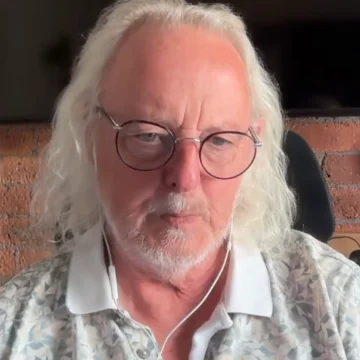
Guest on 2D Is Against My Religion
Barry Bassnett
Digital twin practitioner, author of Tower of Twins
LinkedIn ↗Barry Bassnett is a cartographer and digital twin practitioner and the author of Tower of Twins. On 2DIAMR, Barry Bassnett argued that most digital twins are just “3D postcards” and explained what makes them useful. Recorded live at INTERGEO 2026, Barry Bassnett argued that digital twin clients care about the room, not the coordinates.
Episodes
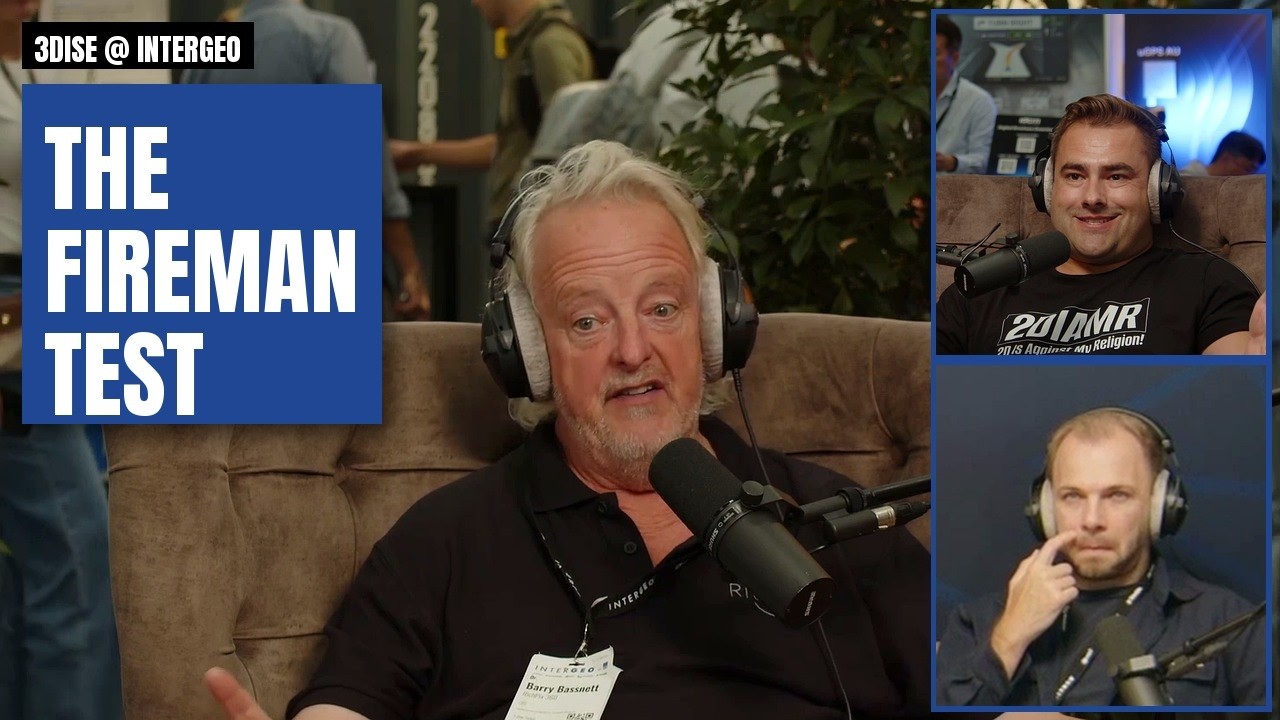 19 min
Expo & conference podcast
Laser scanning accuracy: why digital twin clients don't care – Barry Bassnett
Barry Bassnett · 3DISE Conference
 1 h 32 min
In Barry’s words
“The interesting thing is none of our clients are really interested in about accuracy.”
“It's one variable, and it's probably the least significant.”
“The problem we have from a cognitive psychology point of view is we're not designed to process a point cloud.”
“And you go, "Well, how accurate are you?" It's a, it's a nonsense question.”
“You realize the world is made of rubber.”
“Basically they're just 3D postcards. They're great to look at, and don't get me wrong, visualization is hugely important, but it could be so much more.”
“The first time they can't find it is the last time they use it.”
“A digital twin is only a digital twin if it's updated.”
Quoted in our tech guides
Will AI and robots replace 3D scanning operators and surveyors? What 12 practitioners say →
- “If I'm using AI to regenerate a model, I need to know... I'm happy to take it, but I need to know which bits were regenerated.”▶ 63:57
How to sell 3D scanning and digital twins to clients: what 20 practitioners say →
- “I always ask the question why probably three or four times. 'Why do you need that? Why is that important?' And then you get down to the real problem, because we're not selling the digital twin without solving the problem.”▶ 42:04
- “We're not selling digital twins, we're selling time saving.”▶ 28:02
- “Find one problem and solve that. 'Cause when you solve that, then other people will ask you to solve their other problems in that organization.”▶ 84:09
- “Don't go in and try and sell, 'We can do everything with this.'”▶ 24:21
Is a 3D scan a digital twin? What 13 practitioners say →
- “A digital twin is one where you have the ability to ask the what if question. What if we change the temperature? What if something happened? It has to be interoperable. It has to be a two-way flow of information.”▶ 2:14
- “You've got these beautiful 3D models, point clouds, meshes, and basically they're just 3D postcards.”▶ 1:35
- “Some people think there's some magic button, that you do a laser scan, it converts into a digital twin. Well, it doesn't. You've just gotta have a human harvesting of knowledge to attach the information to it to make it usable.”▶ 8:35
- “Find one problem and solve that. 'Cause when you solve that, then other people will ask you to solve their other problems in that organization.”▶ 84:09
- “We're not selling digital twins, we're selling time saving.”▶ 28:02
- “There's lots of applications where I need accurate geometry. Not as many as most surveyors think.”▶ 16:01
- “You just wanna know it's in room 203, and it needs fixing.”▶ 43:24
- “A digital twin is only a digital twin if it's updated. Otherwise, a historic document.”▶ 26:00
- “A digital twin doesn't have to be a 3D model. It could be a piece of paper. It could be a program.”▶ 2:58
Do you need a licensed surveyor for 3D scanning? What 8 practitioners say →
- “If I was a surveyor, I'd be studying the socks off that. Because unless I do that, I'm gonna be a dinosaur.”▶ 73:45
Scan-to-BIM: from point cloud to Revit model – what 8 practitioners say →
- “But you can use AI to look at the things that are important to the facilities manager, because the facilities manager isn't interested in a Revit model.”▶ 64:49
- “I think AI is a fabulous tool. I use it pretty well every day in my image processing, and certainly in helping me sort through big lumps of information.”▶ 64:31
Questions Barry answered
- Do digital twin clients care about laser scanning accuracy?
- Rarely, according to Barry Bassnett: clients want to know what is in a room and where things are, and accuracy is one variable and probably the least significant. ▶ 1:46
- What happens to a digital twin that is not updated?
- According to Barry Bassnett, it becomes a historic document; SLAM can build the framework, but updates should not require a new survey every time something changes. ▶ 3:49
- Why are point clouds hard for non-specialists to use?
- According to Barry Bassnett, people are not designed to process a point cloud: we remember places as a path at a 1.7 metre horizon, not from a god's eye view. ▶ 6:05
- How do SLAM scanners differ from each other?
- According to Barry Bassnett, many use the same OEM parts, so they should differ in their trajectory, which defines the accuracy, and in what you can do with the data. ▶ 8:33
- What skill will people in reality capture need in the future?
- According to Barry Bassnett, using a camera: AI interpreting images and Gaussian splats you can talk to will matter more than SLAM devices. ▶ 15:28
- How accurate does a digital twin need to be?
- According to Barry Bassnett, generally not very – high accuracy matters mainly for refurbishment, re-engineering and brownfield work. A multi-level building must not twist, but most users need far less than a laser scanner delivers. ▶ 74:51
- Can you build a digital twin from 360° photos instead of a 3D scan?
- Yes, according to Barry Bassnett: in many cases 360 imagery gives enough 3D context. A facilities manager needs to know a light is in room 203 and needs fixing, not that it is 20 mm out. ▶ 43:00
- Can Gaussian splats be used in digital twins if they aren’t measurable?
- Barry Bassnett sees digital twins as the biggest technical use for splats: OpenUSD now supports Gaussian splats, and where geometry matters you can locate the splat and take measurements from the point cloud. ▶ 76:25
- What is OpenUSD and why does it matter for digital twins?
- Barry Bassnett explains that OpenUSD, created by Pixar, references data instead of importing it, supports variants such as lighting setups, and aggregates point clouds, meshes and CAD from different tools like an HTML page. ▶ 52:36
- What is 32-bit photogrammetry?
- According to Barry Bassnett, camera sensors capture about 14–15 f-stops versus roughly 24 for the human eye; bracketing exposures into one 32-bit image keeps detail in highlights and shadows, so models look real even in bright sun. ▶ 79:17
Talks about
Related guests
- Michael Schoelkopf – Director, Product Management Reality Capture, NavVis
- Zlata Karpushina – Go-To-Market Strategist, FJ Dynamics
- Mehdi Boroumand – SLAM scanning practitioner, Australia
- Josip Rukavina – Vectrino
- Arek Szadkowski – Global Lead, ArcGIS Reality, Esri
- Kelly Watt – Reality capture and digital twin programmes