Gaussian splatting vs photogrammetry: what 24 practitioners say
Built from 22 2DIAMR conversations · updated 24 Nov 2026
Short answer
Use Gaussian splatting when people need to see a place – photoreal walkthroughs, visual documentation, presentations, real estate, VR – especially with glass, water, wires or vegetation that break photogrammetry. Use photogrammetry (or a laser point cloud) when you need geometry: measurements, inspection, CAD and BIM, 3D printing, close-up texture detail. Both can come from the same photos, and the guests increasingly combine them: the splat as the interface, the mesh or point cloud underneath for measuring. They disagree on whether splats will replace photogrammetry for most jobs.
At a glance
Best for
Gaussian splatting: Visual documentation, walkthroughs, presentations, real estate, VR and web viewing
Photogrammetry (mesh): Measurements, inspection of cracks and details, CAD/BIM, 3D printing
Looks
Gaussian splatting: Photoreal from a distance; handles glass, water, reflections, thin wires and vegetation; goes soft up close
Photogrammetry (mesh): Sharp high-resolution textures up close; reflective and transparent surfaces often break
Geometry
Gaussian splatting: No real surface geometry; measurements can mislead unless the splat is at metric scale
Photogrammetry (mesh): A real surface you can measure, model and print
Capture
Gaussian splatting: Many angles at several heights, then a curated subset of images; images above 4K mostly slow training
Photogrammetry (mesh): Can use thousands of high-resolution images; benefits from resolution
Light
Gaussian splatting: Overcast light or HDR bracketing; changing shadows create ghosts
Photogrammetry (mesh): Same rules – lighting is baked into the texture
File size and viewing
Gaussian splatting: Millions of splats get heavy; compressed formats (e.g. SOG) make them web-ready
Photogrammetry (mesh): Large meshes can crash browsers; often need tiling, decimation or server-side rendering
Two directions from the same photos
Olli Huttunen, who explains splatting as pointillism in 3D, describes both methods as starting from the same point cloud and then going in different directions: a mesh for physical uses such as 3D printing, or a splat model built to look good on a screen. A splat is millions of soft points trained until the rendered view matches the original photos – and, in Olli Huttunen’s words, it has no geometry.
That framing runs through the whole guide: the question is not which technology is better, but what the client will do with the result.
“You will go to the direction where the model is supposed to run on and look good on your monitor.”
“There is no geometry.”
“Today we're using techniques to extract a fine detailed point cloud from the Gaussians that is way better than what we get from the regular multi-view stereo techniques, especially for thin wires or very delicate structures.”
Where splats win: glass, water, wires and plants
Dylan Gorman of PilotByte names water surfaces and reflective glass as the biggest reason to choose a splat – both break in photogrammetry. Olli Huttunen adds that transparency is almost impossible with mesh structures. Arash Keissami of NIRA has seen splats handle thin wires and interiors remarkably well, and Barry Bassnett likes that vegetation on a splat shows the actual plants rather than a symbol.
The limit, according to Olli Huttunen: splats look photoreal from a distance, but go soft when you get close to leaves or surfaces – and anything that moved during capture can leave ghosts.
“The biggest use case is the reproduction of water surfaces and reflected glass. Those two right there break every single time in photogrammetry.”
“For interiors especially, Gaussian splats really do a remarkable job.”
“It is very good for overall looking, and it looks very photorealistic from far, but if you really want to go near and see all those details from leaf of the trees, it always dismantles.”
“Can measure on them, you can do line of sight or view shed analysis.”
“If they need centimeter accuracy, they would more likely prefer point clouds or working with point clouds.”
Where photogrammetry wins: measuring
Every guest who measures for a living keeps measurement off the splat. Dylan Gorman switches to photogrammetry when a client needs to see cracks or take measurements. Arash Keissami warns that semi-transparent splats can be much larger than they look, so a click can land in the wrong place – NIRA adds mesh and matcap views for that reason. Michael Schoelkopf of NavVis describes the same split: show the splat, measure on the point cloud.
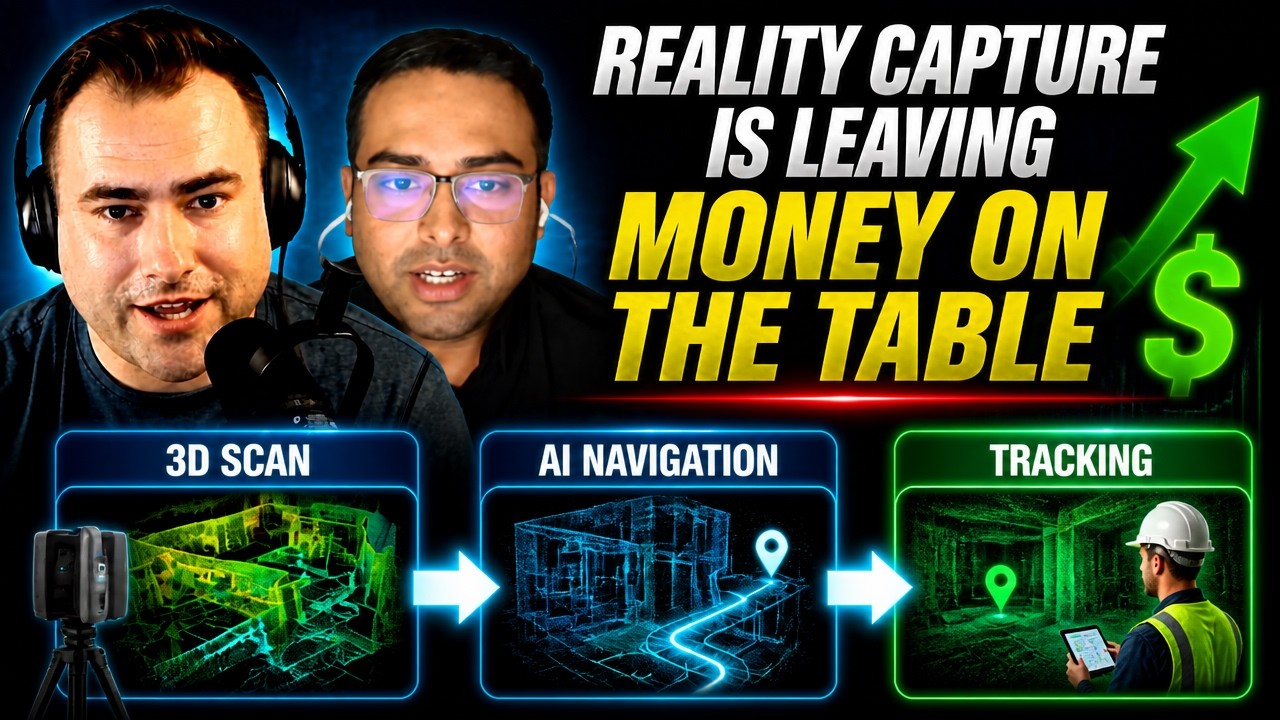
There is one important exception. Nikhil Sawlani of MultiSet AI uses splats for visual positioning – but only splats at metric scale, such as those generated with a LiDAR sensor underneath, or scaled manually. A splat from photos alone won’t do.
The same split shows up in FARO’s workflow for the Rovi i.1: John Chwalibog of Manifold Tech says users navigate the Gaussian splat for the virtual-tour experience, but measure off the point cloud.
Jonathan Stephens of Lightwheel explains why the accuracy numbers in splatting papers score how faithfully the photos are reproduced, not geometry, so Jonathan Stephens treats 3DGS as a visualization layer on top of the point cloud, kept in the same coordinate space. Josip Rukavina of Vectrino adds that, as of January 2026, splats don’t yet give enough data to find cracks on underwater structures, and Michael Rubloff of Radiance Fields suggests running splats and photogrammetry in parallel, because both start from the same structure-from-motion alignment.
“But if they're doing measurements, then yeah, photogrammetry all day long.”
“Gaussian splats are great, but sometimes they can be a little bit deceiving when doing measurements.”
“You have the Gaussian splatting, but you measure on the point cloud.”
“Is your Gaussian splat one-on-one with the real world? Which means if you measure a window in your Gaussian splat, does it actually have the real dimensions of the real world?”
“Gaussian splatting is not for your cadastral survey.”
“We still need point clouds for measurements.”
“Just think of 3DGS as a visualization layer. That's all it is.”
“In underwater, we are looking for the cracks.”
“You can run or you can go on a scooter really fast, and the images will all be geometrically intact and usable for making 3D Gaussian splats with a very, very high level of detail.”
Capture: more angles, fewer (and smaller) images
Barry Bassnett is blunt that image quality decides everything – an out-of-focus capture makes a bad splat just as it makes a bad mesh – and recommends HDR bracketing so harsh sun doesn’t ruin the images. Olli Huttunen prefers overcast weather for the same reason.
The difference is in how the images are used. Olli Huttunen says a splat breaks apart at angles that were never shot, so capture broadly at several heights – but then train on a hand-picked subset, because images above 4K mostly slow the training down. Photogrammetry, by contrast, benefits from thousands of high-resolution images. Dylan Gorman’s water-tower test shows the trade-off: a quick splat was impressive, but the full photogrammetry capture still won on fidelity.
On resolution, Fan Yang of Manifold Tech goes further: from a technical standpoint, according to Fan, splats do not require high-resolution images, and the 2-megapixel global shutter cameras of the Rovi i.1 – which cope well with motion in the field – are already good enough, with a higher-resolution camera as an optional upgrade.
For large mirrors, Mindy Li of XGRIDS captures from at least three angles – straight on and about 45 degrees to each side – at two heights, waist and head, and keeps lighting stationary rather than mounted on the scanner.
“It all comes down to the quality of the image you would put in.”
“It starts to dismantle because it can’t show angles that were not shot.”
“Now granted, the output of the model beats the Gaussian splat because I'm using almost 3,000 20 megapixel images.”
“So the base model itself is good for Gaussian already.”
“At the lowest level of Gaussian splatting models, there is only 0.05% data loaded to the device.”
File size, the browser and VR
Both methods get heavy. Olli Huttunen says a model with 12 million splats runs to gigabytes, and that the compressed SOG format makes a splat about 95% smaller for the web. Arash Keissami says large photogrammetry models and splats alike crash phones, which is why NIRA renders on a server GPU and streams the result.
For speed of production, Alex Harvey of RiVR compares a photogrammetry room – thousands of images, processing, clean-up and retopology – with a Meta Hyperscape splat that gives the same VR experience in hours. Olli Huttunen and Alex Harvey both call a headset the best way to experience splats; Barry Bassnett is sceptical that VR is used much for digital twins.
Łukasz Mirocha of Opus Lab says splats were R&D and demos in the PLY phase; compression – SOG by PlayCanvas, SPZ by Niantic and glTF – opened the door to real projects. Threads of Color, a playable Hong Kong, streams SOG LOD chunks in the browser.
“There was no way you could actually use it in, like, any kind of real project.”
“We had to process it in Reality Capture, export, clean up, simplify, retopo the model. This, oh, my God, I get the same experience in three hours.”
“It will compress losslessly. It is like 95% smaller.”
Which deliverable for which client
Dylan Gorman asks clients one question up front: do you want to look at it, or measure it? A splat covers “it exists, I need to see it” documentation, site walkthroughs and real estate; photogrammetry covers inspection and measurement. Barry Bassnett suggests surveyors deliver a splat of the site alongside the 2D topographic survey, for architects, planners and the public.
Zlata Karpushina of FJ Dynamics sees splats as the layer that helps non-technical stakeholders understand a space – but only one step in a workflow, because visualisation alone solves half the problem. Arek Szadkowski of Esri adds the market view: early adopters still deliver splats as an add-on extra on top of what the client ordered, and tenders that specify them were almost non-existent as of October 2026.
“Are you just trying to look at it like a pretty model? Cool. That's easy.”
“Instead of just giving a 2D layout, you give a Gaussian splat of the site at the same time.”
“Visualization alone only solves half of the problem.”
“Most of the first customer early adopters deliver it as an add-on extra on top of their other products that they were ordered.”
Combine them – and will splats replace photogrammetry?
The practical answer from most guests is to combine. Olli Huttunen reprocesses old photogrammetry datasets as splats and mixes splat environments with mesh models. Barry Bassnett describes a splat as the visual “atlas” with a mesh or point cloud underneath for tagging and coordinates, and Bilawal Sidhu points to Apple’s hybrid of photogrammetry and splats for maps.
On replacement, the guests split. Barry Bassnett says photogrammetry is dying except for specific needs; Dylan Gorman says splats are not a replacement at all; Zlata Karpushina and Michael Schoelkopf see splats as a layer on top of measurable data. Arash Keissami’s view is the safest bet: it is still very early. In Esri’s ArcGIS Reality, according to Arek Szadkowski, splats are simply one more export from the same alignment as orthos, meshes and point clouds – and the new Ground Splats from 360 mobile mapping take their geometry from LiDAR.
Bert Azizoglu of NUBIGON describes the same idea as a hybrid scene: point clouds bring spatial accuracy, Gaussian splats photorealism and the BIM model the deliverable, and having them in one scene lets each validate the others.
Gregor Willhauck of Trimble describes the platform version of the same idea: Trimble Connect is adding Gaussian splats for UAV data from large civil projects (in development as of October 2026), because according to Gregor a point cloud of UAV data can be complex and a surface model loses information – the user then picks a point cloud, splat or mesh, whatever is best for the job.
Tomáš Barnáš of Overhead4D treats laser scanning, photogrammetry and Gaussian splatting as layers: the scan gives scale, photogrammetry the detailed mesh, and splats scaled to the scan become relightable backgrounds in Unreal Engine.
“It's cool to see Apple going in this hybrid approach with photogrammetry mixed with splats.”
“Is it gonna be replaced by Gaussian splats? You know, for many applications, absolutely.”
“Now, is it a replacement? No, not at all.”
“I still feel like we're in the very, very, very early stages of Gaussian splats.”
“This ground splats right now in this release, they are LiDAR driven. It means that the computation is done together with the laser data.”
“So if you are doing feature extraction work, and you show the extracted model or the drawing together with the point cloud, people have more confidence in it.”
“Representing it through a surface model can take out a bunch of information. Gaussian splats really provide a really good way to visualize that.”
“Today, we're actually combining the best of both worlds.”
“Try to just see for what it is good, and then you can combine those technologies.”
Questions
- Can you take measurements on a Gaussian splat?
- The guests advise against it for now: Arash Keissami (NIRA) says splats can be deceiving when measuring, and Michael Schoelkopf (NavVis) and Dylan Gorman measure on the point cloud or photogrammetry instead. Metric-scale splats, e.g. from a LiDAR-based scanner, are the exception Nikhil Sawlani (MultiSet AI) uses for positioning.
- Why do Gaussian splats look better than photogrammetry on glass and water?
- Splats are view-dependent and semi-transparent, so they reproduce reflections and transparency that meshes cannot – Dylan Gorman says water and reflected glass break every time in photogrammetry.
- Can I make a Gaussian splat from my photogrammetry photos?
- Yes – Olli Huttunen says the same image datasets can be reused, and older photogrammetry captures can be reprocessed as splats; train on a curated subset rather than thousands of images.
- Will Gaussian splatting replace photogrammetry?
- The guests disagree: Barry Bassnett expects splats to replace it for many applications, Dylan Gorman says it is not a replacement at all, and Zlata Karpushina (FJ Dynamics) sees splats as a visual layer on top of measurable data.
Every statement above comes from what guests said on 2DIAMR, attributed to them – these are their experiences and opinions, not 2DIAMR’s own measurements.